.svg)

Commentary
Wild, Weird and Wired


This is one in a series of educational columns fostering environmental stewardship and leadership coordinated by ACES — The Alliance of Climate and Environmental Stewards.
They are the old ones, the river-listeners —wild and weird fishes that read the world through currents older than sound, currents both marine and electric.
The old ones follow the Earth’s faint electric breath the way First Peoples followed the teachings of what became the Merrimack River, natural stories written in water, stone, and sky, knowing nothing is separate: the river speaks, the land remembers, and every creature carries a story. The river was a source of trade, travel, and sustenance with its bounty of fish, especially a fish the Penobscot called “kapahse.”
These were the sturgeon. Charles Darwin called them “living fossils,” because fossil evidence showed their appearance has gone virtually unchanged over 250 million years.
Long before humans learned to wire the world, the sturgeon was already reading the river’s electric fields—navigating by signals it mastered when dinosaurs still walked the earth and our own species was millions of years from appearing. The sturgeon does not hunt by sight or speed. It senses. Along its snout and face lie hundreds of tiny organs that read the faint electrical signatures of living things. Every muscle twitch of a crayfish, every pulse of a buried worm, every quiet shimmer of life in the riverbed sends out a signal, and the sturgeon feels it.
Its ancient technology is not an invention but an inheritance in a world alive with currents we rarely notice. What we call “electromagnetic technology” is natural for the sturgeon. Scientists describe these organs as Ampullae of Lorenzini or ampullary electroreceptors—tiny gel‑filled pores that detect faint electric fields. These biological antennae are tuned to the quiet electrical signatures produced by living things. In murky water, in darkness, in the silted bends of great rivers, the sturgeon does not search. It senses. It follows the invisible map of electric fields that ripple through its world.
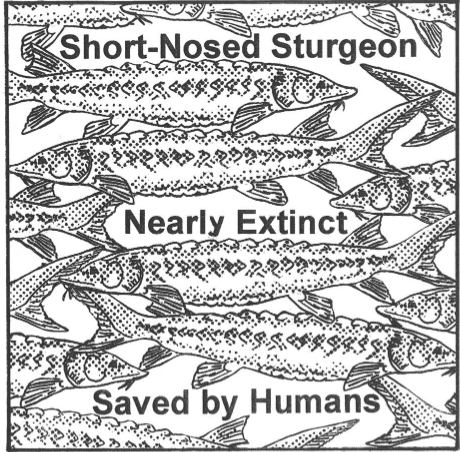
And this world is endangered, according to Micah C. Kieffer and Boyd Kynard, of the National Biological Service, Conte Anadromous Research Cener, who studied the spawning of the shortnose sturgeon in the Merrimack River. Using ultrasonically tagging, in 1996 they estimated that the sturgeon population in the river was the smallest found and likely “vulnerable to extirpation.”
The shortnose sturgeon were historically abundant In Colonial times but overfishing and habitat destruction have contributed to this almost total extinction. The National Oceanic and Atmospheric Administration (NOAA) documents that while more than seven million pounds of shortnose and Atlantic sturgeon were harvested in 1890, only 23,000 pounds were recorded in 1920. This was a decline of more than ninety-nine percent in the Merrimack River, which as an essential and overwintering and migration corridor, is one of the most important shortnose sturgeon habitats in New England.
Since nearly being driven to extinction, the shortnose sturgeon is now protected under both federal and Massachusetts law as an endangered species. With telemetry sensors in the Merrimack River from just below the Essex dam in Lawrences down to Newburyport Bay, scientists continue to record both the numbers and the migration patterns of the sturgeon. Their research. and the protection of endangered species acts, have resulted in a gradual stabilization and increase in the sturgeon population.
The Merrimack River remains a critical refuge for one of the most ancient and remarkable fish on Earth. With its prehistoric appearance, this sturgeon, this wild, weird, wired fish is more than a bridge between eras or a relic of deep time. It is a marvel of evolutionary engineering, and a living emblem of the river’s hidden intelligence. It is essential not only to protect and preserve this fish but also to honor it as well. We honor both the science that reveals its secrets and the Indigenous knowledge that has long recognized the river as a source of life for each of us, a resource to respect and protect.
Daniel Speers is Haverhill’s poet laureate and Chair of Haverhill’s Native American Commemorative Task Force, sponsor of the city’s new First Nations Park. Both the park at 10 am Oct. 3, and Indigenous Peoples Day in Newburyport Oct. 10 will include a mobile live sturgeon display using cultured shortnose sturgeon developed by Micah Kieffer for public outreach and education events throughout New England.
We invite you to stay updated on environmental matters by subscribing to our monthly newsletter on ACES’ website. Please consider joining our community of stewards committed to Make Every Day Earth Day and subscribe to our Instagram and Facebook.
This educational column was originally published by The Daily News of Newburyport on October 2, 2026.